

When most people think about replacing a missing tooth, the focus is usually on appearance, closing a visible gap and restoring their smile. And while that’s absolutely a valid reason to explore your options, there’s something happening beneath the surface that deserves just as much attention: the health of your jawbone.
The connection between dental implants and jawbone health is one of the key reasons implants are considered such an effective long-term solution.
Unlike other forms of tooth replacement, dental implants work with your body to help maintain the bone structure that supports your face and remaining teeth.
What Happens to Your Jawbone After Tooth Loss
Your jawbone relies on regular stimulation from your tooth roots to maintain its density and volume. Every time you chew, bite, or even clench, the force travels through your teeth and into the bone, signalling to your body that the bone is still needed and should be maintained.
When a tooth is lost, that stimulation stops in the area where the root once sat. Over time, the body begins to reabsorb the bone in that region, a process known as bone resoprtion.
This does not happen overnight, but it is progressive. In the first year alone, the jawbone in the affected area can lose a noticeable amount of width and height.
If left unaddressed, missing teeth and bone loss can lead to further complications. Neighbouring teeth may start to shift, your bite can change, and in more advanced cases, the shape of your face may begin to alter, particularly around the cheeks and jawline. This is why tooth replacement and bone support go hand in hand, and why timing matters when considering your options.
How Dental Implants Help Preserve the Jawbone
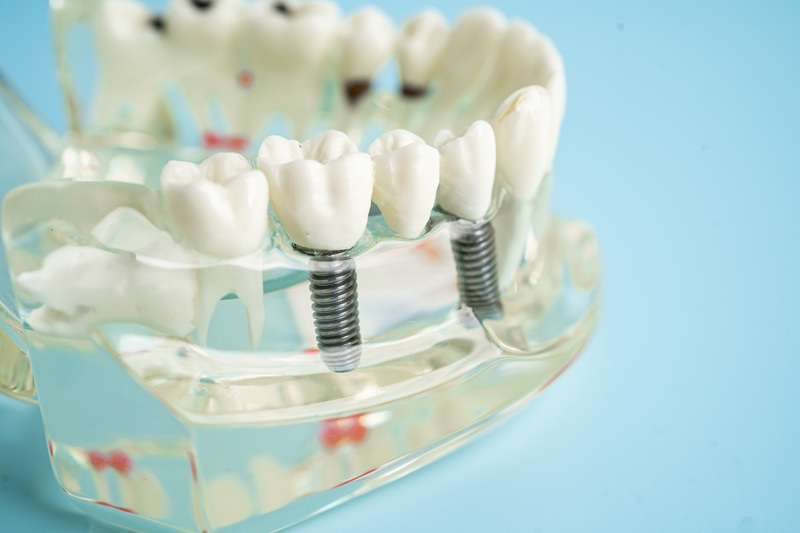
This is where dental implants differ from other replacement options like bridges or dentures. A dental implant is a small titanium post that is surgically placed into the jawbone, acting as an artificial tooth root. Once in position, the implant integrates with the surrounding bone through a natural process called osseointegration in dental implants.
During osseointegration, the bone tissue gradually bonds with the surface of the titanium post, anchoring it firmly in place. This process typically takes a few months, but the result is a stable, long-lasting foundation for a replacement tooth. More importantly for jawbone health, the implant restores the mechanical stimulation that was lost when the natural tooth was removed.
This dental implant bone stimulation is what sets implants apart. By mimicking the function of a natural tooth root, implants signal to the body that the bone is still in use, helping to slow or prevent the deterioration that would otherwise occur.
It’s one of the most significant long-term benefits of dental implants and a major reason dentists recommend them as a preferred option for tooth replacement.
Comparing Implants to Other Replacement Options
Bridges and dentures are both valid ways to restore the appearance and function of missing teeth, and they may be the right choice depending on a patient’s individual circumstances. However, neither option directly addresses jawbone preservation with implants in the way that implant-supported solutions do.
A traditional bridge sits above the gum line and is supported by the teeth on either side of the gap. While it restores your ability to chew and smile confidently, it does not provide stimulation to the bone underneath. Over time, the bone in that area may still recede.
Conventional dentures rest on top of the gums and can actually accelerate bone loss in some cases due to the pressure they place on the ridge of the jaw rather than within the bone itself.
For patients who have already experienced significant bone loss, implant-supported alternatives like All-on-4 dental implants may offer a more stable and bone-friendly solution.
What the Dental Implant Procedure Involves
The dental implant procedure begins with a thorough assessment of your oral health, including imaging to evaluate the current condition of your jawbone. This helps your dentist determine whether you have sufficient bone density to support an implant or whether preparatory treatment like bone grafting may be needed first.
From there, the process generally follows these steps:
- Treatment planning — Your dentist creates a personalised plan based on your imaging, oral health, and goals.
- Implant placement — The titanium post is surgically placed into the jawbone during a minor procedure.
- Healing and osseointegration — Over the following months, the bone naturally bonds with the implant, anchoring it securely in place.
- Crown attachment — Once healing is complete, a custom-made crown is fitted to the implant, restoring the look and function of your tooth.
For patients in or nearby Greenslopes, QLD, our team at Greenslopes Dental Studio now includes Dr. James You, a general dentist with a special interest in dental implants and surgical procedures.
With experience across a wide range of clinical settings both in Australia and internationally, Dr. James brings a thoughtful and thorough approach to every implant case, from straightforward single-tooth replacements to more complex treatment plans.
Preventing Jawbone Deterioration Starts with the Right Conversation
Preventing jawbone deterioration is one of the most compelling reasons to consider dental implants sooner rather than later after tooth loss. The longer a gap is left without a root-level replacement, the more bone volume may be lost, which can make future treatment more complex.
That said, every patient’s situation is different. Factors like overall health, the location of the missing tooth, and the current state of your jawbone all play a role in determining the most appropriate path forward. This is why a personalised consultation is so valuable.
If you’ve lost a tooth or are considering getting a dental implant, our team at Greenslopes Dental Studio is here to assess whether implant-supported tooth replacement is the right fit for you or if another approach makes more sense.
Have a consultation with our dental implant dentist today to get better information about your teeth.
Frequently Asked Questions
Can dental implants prevent bone loss?
Dental implants help stimulate the jawbone in a similar way to natural tooth roots. This stimulation supports bone maintenance and can help slow or prevent the deterioration that typically follows tooth loss.
What is osseointegration?
Osseointegration is the natural process by which the jawbone bonds with the titanium implant post. This creates a strong, stable foundation for the replacement tooth and is a key part of why implants are so effective long-term.
How soon after losing a tooth should I consider an implant?
It’s generally best to explore your options soon after tooth loss, as bone reabsorption can begin relatively quickly. Your dentist can assess your situation and advise on the ideal timing for your case.
What if I’ve already lost bone in my jaw?
In some cases, bone grafting can help rebuild lost bone to support an implant. Your dental team will evaluate your bone density during the planning stage and recommend the best course of action.
Are dental implants suitable for everyone?
Most adults with good general health are candidates for dental implants, but factors like bone density, gum health, and medical history all play a role. A thorough assessment is the best way to determine suitability.

