

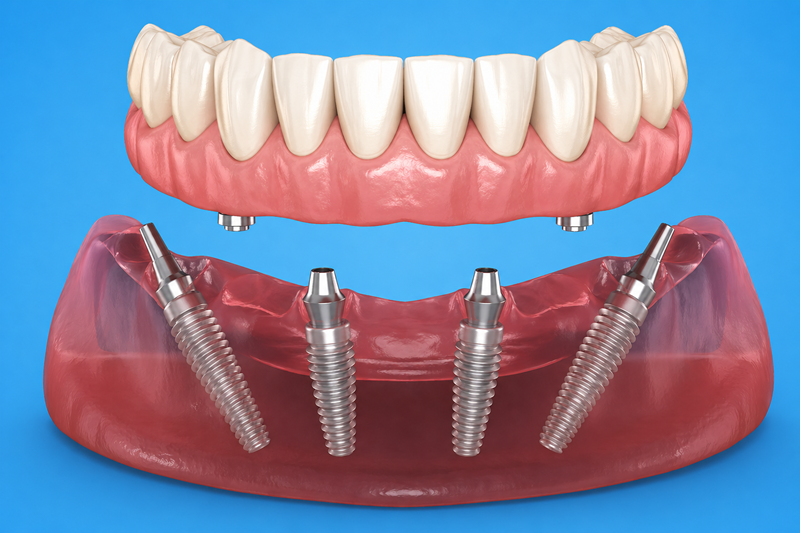
If you’re missing most or all of your teeth, you’ve likely come across two common options: traditional dentures and All-on-4 dental implants. Both are designed to restore your smile and help you eat and speak more comfortably, but the way they work, how they feel, and how they affect your long-term oral health are quite different.
Understanding the key differences between All-on-4 vs dentures can help you make a more confident decision about which path is right for you.
In this guide, we will break down how each option works, what to expect, and the factors worth considering when exploring tooth replacement for multiple missing teeth.
How Traditional Dentures Work
Traditional dentures are removable prosthetics that sit on top of your gums. They are custom-made to match the shape of your mouth and are held in place by suction, adhesive, or natural retention from the gum ridge.
Dentures have been used for decades and remain a practical solution for many patients. They are generally more affordable upfront, don’t require surgery, and can be made relatively quickly. For patients who are not suitable candidates for implants, dentures can be a reliable way to restore basic function and appearance.
However, there are some well-known trade-offs. Because traditional dentures rest on the gums rather than being anchored into the jawbone, they can sometimes shift, slip, or feel less secure, particularly over time as the shape of the jaw changes. This is one of the most common concerns patients raise in a traditional dentures comparison, and it’s a big part of why many people begin exploring denture alternatives.
How All-on-4 Dental Implants Work
The All-on-4 dental implants procedure takes a fundamentally different approach. Rather than resting on the gums, a full arch of replacement teeth is secured onto four strategically placed dental implants within the jawbone. These implants act as anchors, providing a fixed and stable foundation for the prosthetic arch.
The All-on-4 dental implants process is carefully planned using detailed imaging and treatment mapping. The four implants are positioned at specific angles to maximise contact with available bone, which often means that even patients with some degree of bone loss may be eligible without needing bone grafting first.
Once the implants are placed and the arch is attached, the result is a set of teeth that look, feel, and function much closer to natural teeth than removable dentures. For a closer look at the treatment itself, our guide on what All-on-4 dental implants are and how they work covers the fundamentals in more detail.
Key Differences at a Glance
When comparing fixed vs removable dentures, there are several practical differences worth weighing up:
- Stability — All-on-4 implants are fixed in place and don’t shift or slip. Traditional dentures may move during eating or speaking, particularly as the jawbone changes shape over time.
- Bone health — Because All-on-4 implants are anchored in the jawbone, they provide stimulation that helps preserve bone density, something traditional dentures cannot offer. Over time, denture wearers may experience further bone loss, which can affect the fit of their prosthetics.
- Eating and speaking — The stability of All-on-4 implants generally allows patients to eat a wider range of foods and speak more naturally compared to removable dentures.
- Maintenance — Traditional dentures need to be removed for cleaning and soaking overnight. All-on-4 teeth are cared for much like natural teeth, with regular brushing, flossing, and dental check-ups.
- Longevity — With proper care, All-on-4 implants are designed to be a long-term, permanent teeth replacement option. Dentures typically need to be relined, adjusted, or replaced more frequently.
What About Implant-Supported Dentures?
It’s worth noting that All-on-4 is not the only implant-based option. Implant-supported dentures are another alternative that falls somewhere between traditional dentures and a fully fixed solution. These are removable prosthetics that clip onto implants for added stability, while still being taken out for cleaning.
For some patients, implant-supported dentures may be a suitable middle ground, offering more security than conventional dentures without the full commitment of a fixed arch.
Your dentist can help you understand which option aligns best with your needs, lifestyle, and budget.
Is All-on-4 Right for You?
The All-on-4 dental implants procedure does involve surgery and a recovery period, so it’s not a decision to take lightly. However, for patients who are tired of the limitations of traditional dentures or who are facing the prospect of full tooth loss, it can be a genuinely life-changing option.
Good candidates for full mouth dental implants are generally in good overall health, have enough jawbone to support the implants, and are committed to maintaining their oral hygiene long-term. A thorough assessment is the best way to determine whether you’re a suitable candidate.
At Greenslopes Dental Studio, Dr. James You brings a special interest in dental implants and surgical procedures, with experience managing both straightforward and complex implant cases.
Whether you’re exploring All-on-4 for the first time or weighing it against other permanent teeth replacement options, Dr. James and the rest of our team are here to guide you through the process with care and clarity.
Choosing What’s Right for Your Smile
There’s no single answer that works for everyone because every patient’s case is unique. Both traditional dentures and All-on-4 dental implants have their place, and the right choice depends on your individual circumstances, goals, and comfort level.
What matters most is that you have the information you need to make a decision you feel good about.
If you’d like to explore your options for full arch tooth replacement, our team at Greenslopes Dental Studio is happy to have that conversation with you.
Book an appointment with us today to know the most appropriate tooth replacement solution for you.
Frequently Asked Questions
What is the main difference between All-on-4 and traditional dentures?
The biggest difference is how they are supported. Traditional dentures rest on the gums and are removable, while All-on-4 dental implants are fixed onto four implants anchored in the jawbone, providing greater stability and a more natural feel.
Can I switch from dentures to All-on-4 implants?
In many cases, yes. Patients who are unhappy with traditional dentures can often transition to All-on-4. A detailed assessment of your jawbone and overall health will determine whether you’re a suitable candidate.
Is the All-on-4 procedure painful?
The procedure is carried out under anaesthesia, so you should not feel pain during the surgery itself. Some discomfort and swelling in the days following is normal and can usually be managed with prescribed or over-the-counter pain relief.
How long do All-on-4 dental implants last?
With proper care and regular dental check-ups, All-on-4 implants are designed to be a long-term solution. The implant posts themselves can last many years, while the prosthetic arch may need occasional maintenance or replacement over time.
Do All-on-4 implants require special cleaning?
All-on-4 teeth are cared for much like natural teeth. Regular brushing, flossing, and professional cleans are recommended to keep both the implants and the surrounding gum tissue healthy.

