

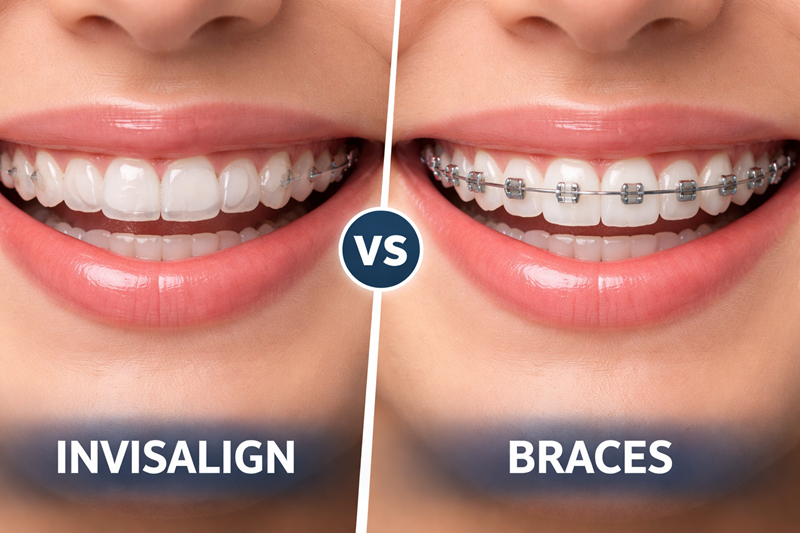
Thinking about straightening your teeth, but not sure where to start? You’re not alone. For many people, the decision between Invisalign and braces is one of the first (and most confusing) steps on the path to a healthier smile.
To know better, we think you should learn the difference between these two teeth straightening options.
Let’s help walk you through how each treatment works, what the key differences are, and what factors are worth considering, so you can feel genuinely informed when you sit down with your dentist to talk through your options.
How Do Traditional Braces Work?
Traditional metal braces are one of the most established orthodontic treatment options available. The system works by bonding small metal brackets directly onto the surface of each tooth, then connecting them with a thin wire. Over the course of your treatment, that wire is periodically adjusted to apply gentle, consistent pressure that gradually guides your teeth into better alignment.
Because the brackets are fixed to your teeth, fixed braces treatment works continuously, 24 hours a day. This makes them particularly effective for more complex alignment issues, including significant crowding, bite problems, or cases where precise control over individual tooth movement is needed.
One thing worth understanding is how the adjustment process works. Each time you visit your dentist, the wire is tightened slightly to maintain the right amount of pressure on your teeth. This is why braces require regular check-up appointments throughout your treatment, typically every six to eight weeks.
How Does Invisalign Work?
Invisalign takes a fundamentally different approach to teeth straightening. Instead of brackets and wires, it uses a series of custom-made, removable clear aligners, each one designed using 3D imaging technology to move your teeth a little further with every set.
You wear each set of aligners for one to two weeks before moving on to the next in the series. Over time, this gradual progression shifts your teeth toward their target position. The aligners need to be worn for around 22 hours per day to make a gradual difference for your teeth. That means they only come out for eating, drinking anything other than water, and cleaning your teeth.
One of the more recent advances in Invisalign treatment is remote monitoring technology, like Dental Monitoring. This app allows patients to send weekly photos of their teeth from home to track progress without requiring frequent in-clinic visits. You can experience this app with our team at Greenslopes Dental Studio.
Invisalign vs Metal Braces: Understanding the Key Differences
Visibility
Clear aligners are made from smooth, transparent plastic and sit closely against the teeth, making them far less noticeable than metal brackets and wires. For adults and teens who want a discreet orthodontic treatment, this is one of the most significant clear aligner benefits.
Traditional braces are more visible, though tooth-coloured ceramic bracket options exist for those who prefer something less prominent than standard metal.
Comfort and Oral Sensation
Both treatments involve some degree of adjustment as your teeth move, which is completely normal and a sign that the treatment is working. The experience, however, differs between the two.
With Invisalign, the aligners are smooth-edged and don’t involve any brackets or wires, which reduces the risk of irritation to the inside of your cheeks or lips. With traditional braces, it’s common to experience some tenderness after adjustment appointments, and the hardware can occasionally cause minor irritation until your mouth adapts.
Your dentist will provide more information on how to manage any discomfort from Invisalign and traditional braces.
Eating and Oral Hygiene
Because Invisalign aligners are removable, there are no restrictions on what you eat during treatment. You simply take them out before meals and put them back in afterwards. Brushing and flossing also remain straightforward, since there’s nothing fixed to your teeth to clean around.
With braces, especially for crooked teeth, certain foods need to be avoided throughout treatment, particularly anything hard, sticky, or crunchy that could damage the brackets or wires. Cleaning your teeth does require more effort, as you will need to brush carefully around each bracket and use interdental brushes or floss threaders to clean between teeth effectively.
Treatment Suitability
Both Invisalign and braces treatment may address a wide range of orthodontic concerns, including crowding, gaps, and general misalignment among them. However, they are not always interchangeable.
Traditional braces tend to be the preferred option for more complex cases, particularly those involving significant bite correction or situations where very precise tooth movement is required. Invisalign has advanced considerably in recent years and is now suitable for mild to moderately complex cases in both adults and teens.
The right choice will depend on your individual clinical needs, which is something your dentist can assess during a consultation.
Understanding the Price Difference Between Braces and Invisalign
In Australia, cost is a practical consideration, and it’s worth understanding how pricing works for both treatments.
The price difference between braces and Invisalign is not always as straightforward as people expect. Both treatments are priced based on the complexity and duration of your individual case rather than a flat rate, which means costs can vary quite a bit from person to person.
It’s also worth checking your private health fund cover. Many health funds include an orthodontic benefit that can contribute toward either treatment. At Greenslopes Dental Studio, we’re happy to help you navigate your cover. We also offer flexible payment plans to help spread the investment over time.
You can also use our Invisalign payment calculator online to get a clearer sense of estimated costs before your appointment.
Which Treatment Is Right for You?
The honest answer is that there’s no universal “better” option. The right treatment is the one that suits your teeth, your lifestyle, and your goals. What is most important is getting a professional assessment so your care plan is tailored to your individual needs.
If you’re considering getting clear aligners or Invisalign in Greenslopes, QLD, our team at Greenslopes Dental Studio is here to help you understand your case and options better. Your preferences will also be taken into consideration.
Book an appointment with us today to discuss.
Frequently Asked Questions
What is the main difference between Invisalign and traditional braces?
The biggest difference is how each treatment straightens your teeth. Traditional braces use fixed metal brackets and wires bonded to your teeth, applying continuous pressure around the clock. Invisalign uses a series of removable clear aligners that are swapped out every one to two weeks.
Both can address a range of alignment concerns, but they differ in visibility, comfort, and lifestyle impact, which is why the right choice depends on your individual needs. Talking to a qualified dentist is advised.
Is Invisalign as effective as traditional braces?
For mild to moderately complex cases, Invisalign can be a very effective orthodontic treatment option. Traditional braces remain the preferred choice for more complex alignment or bite correction cases, where highly precise tooth movement is needed.
Your dentist will assess your teeth and recommend the most suitable treatment for your specific situation.
How long does Invisalign treatment take compared to braces?
Treatment duration varies from person to person and depends on the complexity of your case. In general, both Invisalign and braces treatment can take anywhere from several months to a couple of years. Your dentist will give you a more accurate timeframe after evaluating your teeth during a consultation.
Is there a significant price difference between braces and Invisalign?
Costs for both treatments are determined by the complexity and length of your individual treatment plan, rather than a fixed price. As a result, the price difference between braces and Invisalign can vary. At Greenslopes Dental Studio, we offer flexible payment plans and can help you understand what your private health fund may cover. You can also use our online Invisalign payment calculator for an estimate before your appointment.
Can I eat normally with Invisalign?
Yes. One of the key benefits of Invisalign is that the aligners are removable, so there are no food restrictions during treatment. You simply take them out before meals and put them back in when you’re done. With traditional braces, it’s recommended to avoid hard, sticky, or crunchy foods that could damage the brackets or wires.
How do I clean my teeth with Invisalign vs braces?
With Invisalign, brushing and flossing remain largely the same as usual. You remove the aligners, clean your teeth normally, and clean the aligners separately. With traditional braces, you will need to clean more carefully around each bracket using interdental brushes or floss threaders to remove food and plaque effectively.
Is Invisalign suitable for teenagers?
Yes, Invisalign offers a treatment option designed specifically for teens, which includes features to accommodate still-developing teeth. That said, suitability depends on the individual case and the level of responsibility required to wear the aligners consistently for 22 hours a day. Your dentist can advise whether Invisalign or traditional braces would be the better fit for your teenager.
How do I get started with Invisalign at Greenslopes Dental Studio?
Simply book a consultation with our team. During your appointment, we’ll assess your teeth, walk you through your treatment options, and answer any questions you have. Call us on 07 3733 3555 or book online.

